


How Can It Be a Buyer’s Market When Mortgage Rates Are So High?
“If this is a buyer’s market,” Fiona asked over coffee, “why does the mortgage payment look like it needs its own mortgage?” Scott laughed. But he had the same question.
Our couple had steady jobs, savings, and a dog who deserved a backyard. Still, every interest-rate headline sent them back to rental listings.
Their confusion makes sense. How can conditions favor buyers when financing feels so expensive?
Because :
A buyer’s market describes your choices and negotiating power.
Affordability describes whether the numbers work for you. Those two things don’t always move together.
Let’s look at what’s available, why buying can make sense, and what buyers are actually buying.
More Choices Can Create an Opening 
When more homes are available than willing buyers, sellers have to work harder to attract an offer.
Depending on the property, that may create room to negotiate:
-
A lower purchase price.
-
Help with eligible closing costs.
-
Repairs or other contract terms.
-
Financing incentives, particularly on new homes.
Higher rates can contribute to this imbalance by keeping buyers on the sidelines. That hesitation can leave those who are ready with more options and negotiating room. But conditions vary by neighborhood, price range, and property.
So, Scott asked, “The thing making us hesitate could also be giving us an opening?”
Exactly. An opening worth examining—not an automatic reason to buy.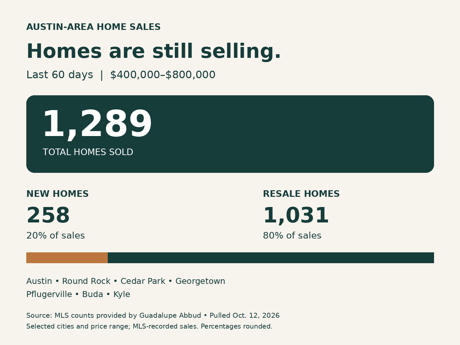
These figures don’t tell us whether every buyer got a bargain, or establish a buyer’s market by themselves. They do tell us that people are still finding homes and terms they’re willing to purchase.
The question is: What would make a purchase work for you?
A Lower Rate Isn’t the Whole Deal
Fiona and Scott started with one question: “What’s the rate?”
Then they learned to ask a better one: “What’s the whole deal?”
A higher-priced home with a lower rate can cost less each month than a lower-priced home with a higher rate. The down payment, taxes, insurance, mortgage insurance, and HOA fees also matter. Closing costs and maintenance affect how much financial breathing room you have.
That’s why I like to work through your homebuyer equation:
Payment + Cash + Location + House + Deal.
Can you afford the complete monthly cost? Will you have savings left after closing? Does the home fit your life? Are the negotiated terms meaningful to you?
An attractive rate deserves attention. So does an attractive purchase price. Neither should make the decision alone.
Why Can a Builder’s Lender Advertise a Lower Rate?
If you’ve watched my new-homes video, you may be wondering how a builder can advertise financing below the rates you see elsewhere.
Before getting attached to an advertised rate, ask:
How long does it last? Which homes qualify? What credit score, down payment, and loan type are required? What are the fees and APR? Must I close by a certain date?
Also ask whether choosing the financing incentive affects other available discounts. Compare written lender estimates for the same purchase scenario.
The goal is to understand the home’s price, cash needed, and payment over time—not just the biggest number on the advertisement.
Why Are Mortgage Rates So Hard to Predict? 
Several forces drive mortgage rates, including inflation expectations, long-term bond markets, investor demand for mortgage-backed securities, and lenders’ costs and risk.
The Federal Reserve influences the broader interest-rate environment, but it does not directly set the rate on your 30-year mortgage. Your credit profile, loan type, down payment, and lender also affect your offer.
That’s why a headline can describe the general market without telling you exactly what financing is available to you.
We can spend a lot of energy trying to predict the next change. Or we can use that energy to improve the pieces we can influence: our credit, savings, budget, home search, and negotiations.
The Cost of Waiting Deserves a Comparison
Waiting may be the right decision. It can give you time to save, reduce debt, improve credit, or clarify where you want to live.
But waiting also has trade-offs: continued housing expenses, changing home prices, changing incentives, and the possibility that a home you love sells.
Lower rates could improve affordability. They could also attract more competing buyers. Neither outcome is guaranteed.
Rather than assuming waiting will save money—or that buying now always wins—compare realistic scenarios.
Does the purchase work at today’s payment, without needing a future refinance or price increase to rescue the decision?
That was the turning point for Fiona and Scott.
They found a home with a shady backyard and a seller willing to negotiate. Their lender helped them review the full costs. They had room in their budget and savings left for the unexpected.
“We were waiting for the headlines to tell us it was safe,” Fiona said. “We needed to see whether it made sense for us.”
Scott looked toward the backyard : The dog calls it a stupendous idea.
What Can You Control Today?
You can’t control tomorrow’s mortgage rates. You can control how prepared you are—and which deal you accept.
After more than 20 years in real estate, I’ve learned this: the decision has to fit your life as well as your finances.
You don’t have to be fearless—or wealthy. You need to be prepared.
Text “LET’S LOOK” to 512-801-6564, and let’s work through your homebuyer equation together. New construction or resale, we’ll look at the possibilities and the numbers.
No pressure—just real talk.